
8 short sessions · 52 minutes
Your workday is the wrong shape.
Most workdays are built around an average system. Yours isn't average. This course reshapes the day around your actual recovery capacity — without you having to disclose anything personal.
By Markus Fordemann. From years of patching a workday that didn't fit. 52 minutes, two scripts, one decision frame.
Markus Fordemann
Guide
No deadlines. Learn whenever it suits you.
One-time purchase. Yours forever. Go at your own pace.
What you will be able to do
- 1You use the anchor-and-escape move to make it through an open office
- 2You use two short sentences that get you what you need without disclosing anything personal
- 3You build a 90-minute deep-work window that actually holds
- 4You handle meetings with a clear before, during, and after move
- 5You sort feedback before it lands and weighs on your week
Is this for you?
This may help if…
- You're competent at the work but flattened by the shape of the day
- Open offices, back-to-back meetings, or constant interruption wreck you
- You can't disclose your sensitivity at work and don't want to
- Generic productivity advice has never matched your reality
- You want a clear question for "should I adapt, negotiate, or leave"
This may not be right if…
- You're looking for career coaching or job-search support
- Your role has no flexibility at all — even with the scripts, the levers may be too few
Why this Deepening, by Markus
Markus has done this redesign on himself. He knows the workday that ate his evenings and the slow rebuild of one that doesn't. This is the kit he uses now, and what he wishes he'd had a decade earlier.
Time & energy
1 modules · 8 short sessions · 52 min
8 sessions of about 6 minutes. Read at your own pace. Come back when you need to.
Each session is short enough for the days when there isn't much left in you. No setup, nothing to perform, no app to fill in.
About This Deepening
What You'll Learn
1Redesign Your Workday Around Your Actual Limits8 sessions
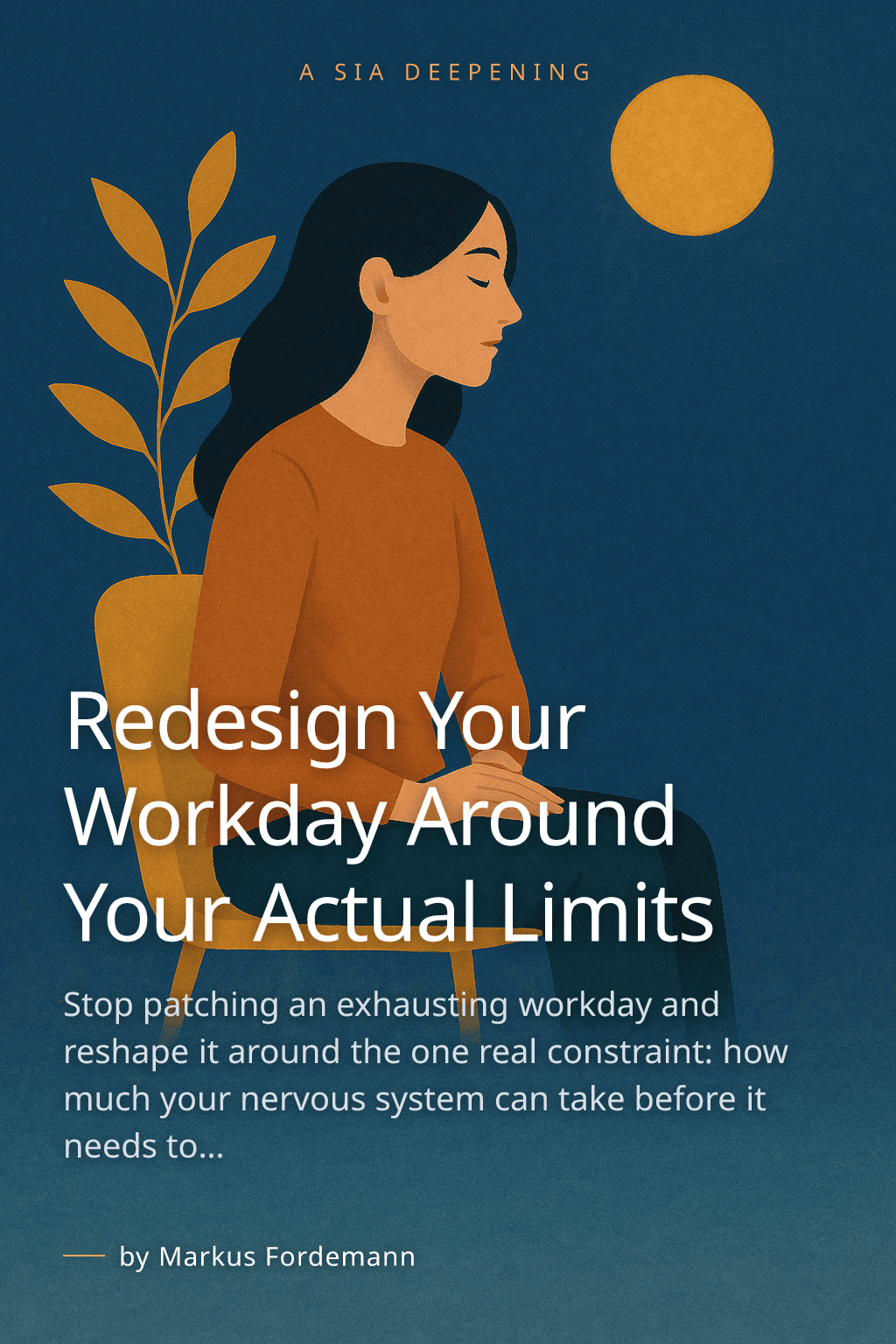
Stop patching an exhausting workday and reshape it around the one real constraint: how much your nervous system can take before it needs to recover.
- Your Workday Is the Wrong ShapeFree Preview7m
- Anchor and Escape: Surviving the Open Office8m
- Two Sentences That Get You What You Need6m
- Before, During, and After a Meeting8m
- 90 Minutes Is Enough: Building Your Real Deep-Work Window7m
- Sorting Feedback Before It Lands6m
- Name What You Learned This Week4m
- Adapt, Negotiate, or Leave: The Three Real Questions6m
Free Preview
Read a sample session to see if this Deepening is right for you.
Your Workday Is the Wrong Shape
It's 3:47 on a Tuesday. You've answered every message, sat through two meetings, smiled at three people in the kitchen, and the document you actually need to finish is still open in a tab somewhere. You're not lazy. You're not behind. You're emptied out in a way that no amount of coffee or willpower will refill before tomorrow morning, when it starts again.
If you've ever read a productivity article and thought, this assumes I have energy I do not have, you were right. Most workday advice is built for people whose battery refills overnight. Yours may not, because yours is spending energy on things the average colleague's nervous system filters out automatically: the hum of the air conditioner, the open Slack channel, the half-overheard conversation, the meeting where someone's tone was off. You do not have a focus problem. You have a recovery problem.
This is the reframe the whole course rests on. The workday itself is the wrong shape for you, and no amount of optimizing inside that shape will fix it. The shape has to change. The course gives you one through-line for doing that: Notice / Negotiate / Recover. First you name the specific thing draining you. Then you change the structure where you can. Then you install a real reset before the cost builds up.
Try this now, on paper or a phone note, about 30 seconds: answer one question. Where did my energy actually go yesterday? Don't list tasks. List inputs, under three columns: sensory (lights, noise, screens, smells), social (meetings, small talk, being watched), and emotional (a tense email, an unspoken mood, news between tasks). Two or three entries per column is plenty.
This is the recovery-debt audit. It's the first move because the cost has been invisible. Once you can see where energy went, the rest of the course has somewhere to land. The two-sentence accommodation request in lesson 3 needs a target. The 90-minute deep-work window in lesson 5 needs honest numbers. The adapt-or-leave question at the end of the course needs evidence.
Notice what came up doing the audit. Relief that something on the list finally matched your week? Or resistance, because seeing it written down makes it real? Both responses make sense. You don't have to do anything with the list yet. Naming is the whole job of Notice.
In the next lesson, Anchor and Escape: Surviving the Open Office, we'll take the sensory column and turn it into three physical escape routes you can use before the bucket overflows.
Who created this Deepening
Markus Fordemann
View full profile →
One-time purchase. Yours forever. Go at your own pace.
8 sessions
Created for highly sensitive people
This Deepening includes
- 8 sessions across 1 chapters
- 52 minutes of content
- ✓Lifetime access
- ✓Learn at your own pace
- ✓Downloadable PDF (EN + DE where available)
Honest answers to common questions
Won't my boss notice if I change my routine?▾
The course doesn't ask you to change anything visible without a reason. The two sentences in Session 3 get you what you need without disclosing anything personal.
I don't have a flexible job.▾
The course is for people without much flexibility — it works on the small levers that exist. Session 8 helps you see when the answer really is "leave".
Is this another "do deep work in the morning" course?▾
No. The deep-work window is 90 minutes, sized for a sensitive system, and you pick the time. The course is about your recovery shape, not anyone's productivity ideology.
What if I can't even take a real lunch?▾
Session 2 is built for that. The anchor-and-escape move is designed to work in two-minute pieces if that's all you have.
About this Deepening
This is a self-guided course. It is not therapy, medical treatment, or a substitute for clinical support. It is for people who want to understand their own patterns and build something small around them.
Not the right fit if
- Diagnosed conditions that need clinical attention
- Acute mental health crisis
If you need immediate help
If you are in immediate distress or thinking about ending your life, please reach out. You do not have to handle this alone. In the US, call or text 988 (Suicide & Crisis Lifeline). In the UK and Ireland, call 116 123 (Samaritans, free, 24/7). In Australia, call 13 11 14 (Lifeline). For any other country, you can find a free, confidential helpline at https://findahelpline.com.