
12 sessions · 90 minutes · 21 days
Come back, one small phase at a time.
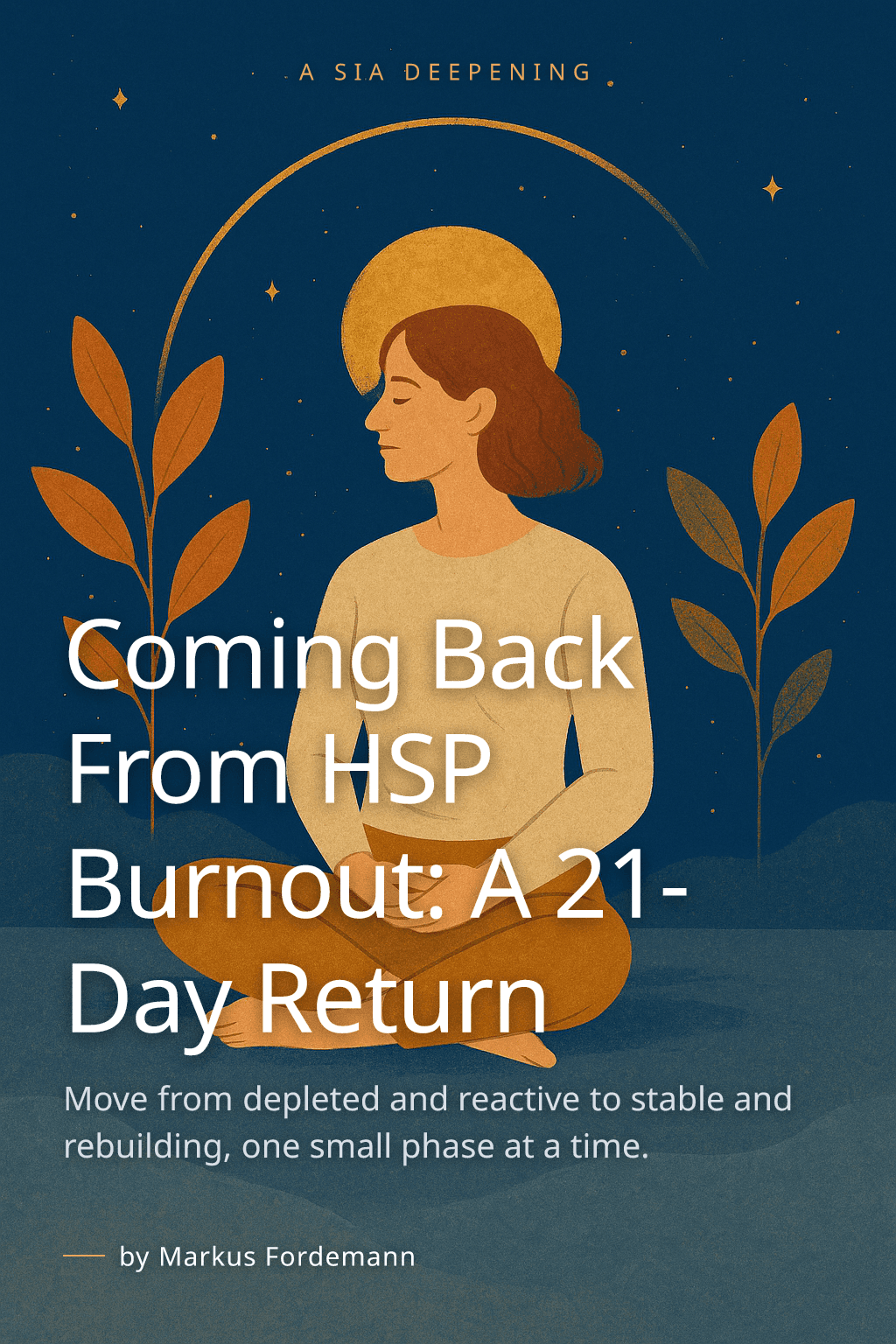
You don't return from burnout with more willpower. You return with a phased plan that meets your actual capacity today. This is the 21-day version, with an energy map and an early-warning system you can keep.
By Markus Fordemann. From his own slow return. 90 minutes total, twelve short sessions, no productivity push.
Markus Fordemann
Guide
No deadlines. Learn whenever it suits you.
One-time purchase. Yours forever. Go at your own pace.
What you will be able to do
- 1You map exactly where your energy is leaking (the Bleed Map)
- 2You triage three categories of boundaries you can renegotiate today
- 3You lower your sensory baseline so tomorrow doesn't start in the red
- 4You use the Minimum Viable Day template on the hardest stretches
- 5You build your personal energy budget and a ten-minute slip protocol
Is this for you?
This may help if…
- Your tolerance for everyday input has been shrinking for weeks
- Rest hasn't been enough — you sleep but you don't feel restored
- Standard burnout advice ("take a holiday") assumes a system you don't have right now
- You want a phased plan, not a list of habits to add
- You want an early-warning system so this doesn't happen again
This may not be right if…
- You're in acute mental health crisis — please get clinical support first
- You're looking for a return-to-work coaching programme
Why this Deepening, by Markus
Markus has been to the floor of this and walked back up, slowly, with no productivity push. He knows the months where everything is loud and the slow taking-back of small things. This course is the path he wishes had existed.
Time & energy
1 modules · 12 short sessions · 90 min
12 sessions of about 7 minutes. Read at your own pace. Come back when you need to.
Each session is short enough for the days when there isn't much left in you. No setup, nothing to perform, no app to fill in.
About This Deepening
What You'll Learn
1Coming Back From HSP Burnout: A 21-Day Return12 sessions
Move from depleted and reactive to stable and rebuilding, one small phase at a time.
- What Burnout Feels Like in a Sensitive SystemFree Preview8m
- The Bleed Map: Where Your Energy Is Going9m
- Check-In: Where Are You Right Now?5m
- Emergency Boundary Triage: Three Categories to Renegotiate9m
- Lowering the Sensory Baseline Today7m
- The Minimum Viable Day Template8m
- One Practice, Chosen and Named7m
- Check-In: What Has Shifted Since Lesson One?5m
- Graduated Re-Engagement: The Yes-and-Check8m
- Your Personal Energy Budget9m
- The Five Warning Signs and the Ten-Minute Slip Protocol8m
- What You Carry Forward From Here7m
Free Preview
Read a sample session to see if this Deepening is right for you.
What Burnout Feels Like in a Sensitive System
It's a Tuesday evening. You're standing in the kitchen, holding a clean mug, and you cannot remember if you came in here to make tea or to put the mug away. The dishwasher is humming. Someone in the other room asks you a small, kind question, and you feel your jaw tighten before you even hear the words.
If a version of that scene is familiar, this lesson is for you. You are probably not lazy, dramatic, or suddenly bad at your life. Your tolerance has been shrinking for weeks, maybe months, and your system is telling you in the only way it knows how.
HSP burnout doesn't usually arrive as a single dramatic crash. It arrives as a slow narrowing. Things that used to be fine, a phone call, a short errand, a friend changing plans, now cost a whole evening. Small annoyances produce big reactions, and you feel ashamed of the size of the reaction, which costs you even more. Standard recovery advice (sleep more, exercise, see friends) often misses because it asks you to add things to a system that first needs to stop adding anything at all.
That's the shape of this course: Stop / Settle / Rebuild. You cannot Settle while the drain is still wide open, and you cannot Rebuild on a nervous system that hasn't Settled. Most people try to skip straight to Rebuild and wonder why it doesn't hold.
Try this now, in about thirty seconds. Run the tolerance-shrink inventory. Read these six signs and silently count the ones that have been true for more than two weeks:
- Things that used to be fine now need a recovery day.
- Small triggers produce outsized responses you later regret.
- Background noise (fridge, traffic, a tap) feels louder than it used to.
- You're cancelling plans you'd normally enjoy.
- Decisions that used to take a minute now feel impossible.
- Your body feels braced even in safe rooms.
One or two: you're tired and tender, and Settle work will likely be enough. Three or four: you're in real burnout territory, and Stop comes first. Five or six: you're deep in it, and your only job this week is Stop. That's not a failure score. That's a map.
Notice how the count landed. Relief that there's a name for it? Resistance, because naming it makes it harder to push through? Both responses make sense, and neither one is wrong.
In the next lesson, The Bleed Map: Where Your Energy Is Going, you'll find out exactly where the drain is happening, so Stop has somewhere concrete to begin.
Who created this Deepening
Markus Fordemann
View full profile →
One-time purchase. Yours forever. Go at your own pace.
12 sessions
Created for highly sensitive people
This Deepening includes
- 12 sessions across 1 chapters
- 90 minutes of content
- ✓Lifetime access
- ✓Learn at your own pace
- ✓Downloadable PDF (EN + DE where available)
Honest answers to common questions
21 days isn't long enough.▾
The 21 days are a phased frame, not a finish line. Most people use the course for the first 21 days and then carry the energy map forward indefinitely.
I can't take time off work.▾
The course assumes you can't. Every session is built for someone still in life, working, parenting, or both. The Minimum Viable Day template is for exactly that.
How is this different from a burnout self-help book?▾
It's not a book. It's a phased frame with named moves. Each session is short and built to be done flat. You don't have to finish chapters in order.
Is this for autistic burnout too?▾
It's written for sensitive systems, but the phased frame applies. If your burnout has specific autistic features, this course works as a companion, not a replacement for autism-specific resources.
About this Deepening
This is a self-guided course. It is not therapy, medical treatment, or a substitute for clinical support. It is for people who want to understand their own patterns and build something small around them.
Not the right fit if
- Diagnosed conditions that need clinical attention
- Acute mental health crisis
If you need immediate help
If you are in immediate distress or thinking about ending your life, please reach out. You do not have to handle this alone. In the US, call or text 988 (Suicide & Crisis Lifeline). In the UK and Ireland, call 116 123 (Samaritans, free, 24/7). In Australia, call 13 11 14 (Lifeline). For any other country, you can find a free, confidential helpline at https://findahelpline.com.